 PLATO SCROLL
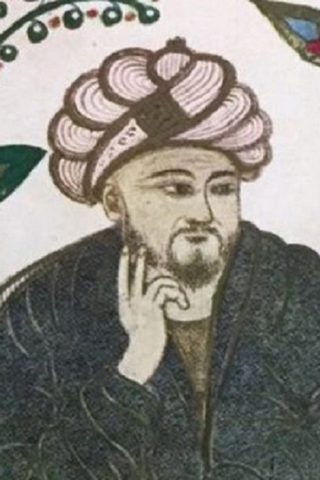
Al-Farabi
c. 872–950
'The Second Teacher' — the Islamic philosopher who joined Plato, Aristotle, and emanation into one system.
About Al-Farabi
Al-Farabi, working in Baghdad, was so revered for his mastery of logic and philosophy that he was called 'the Second Teacher' — second only to Aristotle himself. He laboured to show the deep harmony of Plato and Aristotle, and built a grand Neoplatonic system in which all things flow by emanation from the First, the One, through a hierarchy of cosmic Intellects down to our world.
Following Plato's Republic, he described the Virtuous City ruled by a philosopher-prophet, uniting wisdom and revelation. His synthesis laid the foundation for all later Islamic philosophy and, through it, for the Latin scholastics; his greatest heir was Avicenna.
Abu Nasr al-Farabi was born in Central Asia, by tradition at Farab on the Syr Darya, and came to Baghdad, where he studied logic with Christian scholars of the Syriac-speaking Aristotelian school who stood in a line of teaching reaching back to late antique Alexandria. Late in life he moved to Syria, spending time at the court of Sayf al-Dawla in Aleppo, and he died in Damascus around 950.
His logical work — commentaries and paraphrases on the Organon — earned him his title, and his Enumeration of the Sciences mapped the whole field of learning. In The Philosophy of Plato and Aristotle he set out the aims of each philosopher, and he also wrote a summary of Plato's Laws and a major treatise on music. The harmonizing project was made easier by the Arabic Theology of Aristotle, in reality a paraphrase of parts of Plotinus, which seemed to give Aristotle a Neoplatonic theology; the attribution to him of the treatise On the Harmonization of the Opinions of the Two Sages has, however, been questioned by some modern scholars.
In his cosmology a series of ten intellects proceeds from the First, each associated with a celestial sphere; the last, the Active Intellect, governs the sublunary world and illuminates human minds. Prophecy, on this account, is the reception of the Active Intellect's influence by an exceptionally perfect imagination, so that the prophet conveys in images what the philosopher grasps in concepts. The ideal ruler of the Virtuous City is both at once. Maimonides held his logic in the highest esteem, and Averroes engaged his ideas in turn.
See also
From the Plato Scroll Encyclopedia · open this entry in the reader
Works in the library — 1
- The Virtuous City· Claude AIENENread →